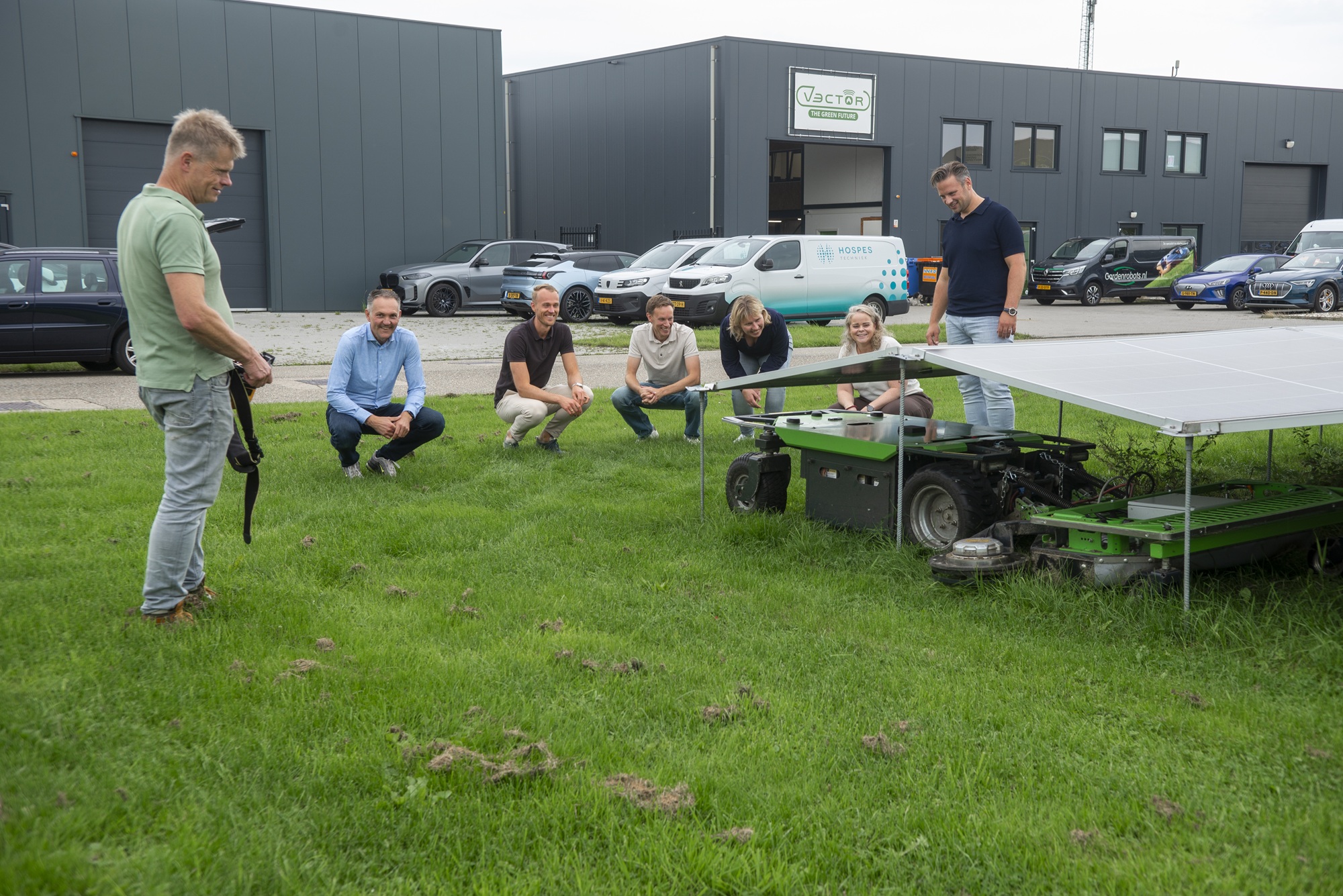
There was already significant interest in Vector Machines’ electric, autonomous robotic mower. Now that the machine is proving itself at solar farms, demand has only increased. It’s time to scale up. For NOM, that’s reason enough to get involved again, this time as a shareholder.
“Our machines are already being used at solar farms in several countries,” says Jan-Dirk van der Tol. “Demand is enormous.” He is a co-founder of Vector Machines, a company based in Heerenveen that builds electric, autonomous robotic mowers for areas where obstacles and poor GPS reception make mowing difficult—including solar farms. Thanks to a combination of GPS-RTK and LIDAR—a technology that scans the surroundings with lasers—the machine maintains its course accurately, even if the GPS signal is completely lost.
To meet demand, however, the company needed additional capital and expertise. To that end, Vector Machines approached the NOM, which is now acquiring a stake in the company together with the Eindhoven-based investment fund Lumaux. “We’ve known Vector Machines for several years and have supported the company through various phases,” says Daniëlle van Dalfsen, investment manager at NOM. “We see that the company is at a tipping point. The technology is in place, and market demand has been demonstrated. The next step is scaling up. That’s why we’re eager to help the company move forward during this important phase.”
Market player
Van der Tol founded Vector Machines in 2022 with Sander Steegstra. Two years later, the company approached NOM for the first time. At that time, it had just completed a working prototype and received a subordinated loan. NOM indicated even then that it would be happy to revisit the matter if the company developed well and continued to grow. With this new investment, that commitment is now being fulfilled.
However, NOM preferred to invest alongside a market partner. “The fact that NOM was the first to express interest in participating helped speed things up,” says Van der Tol. “When a market partner sees that NOM—which has known us practically from the start—has confidence in us, that helps.” That partner was found in Lumaux, an investment fund that focuses on Dutch high-tech startups and scale-ups. “The people behind Lumaux understand both mechanical engineering and software,” says Van der Tol. “Exactly what we do, too. They bring not only capital but also technical expertise.”
The NOM is also pleased with Lumaux’s arrival. “The great thing about this investment is that it brings together public and private capital,” Van Dalfsen emphasizes. “By combining the strengths of NOM and Lumaux, we can offer Vector Machines the expertise, network, and capital needed to enter its next phase of growth.”
Significantly further developed
The investment comes at a time when the machine has undergone significant further development. The current model, the Vector WD4, is narrower and more maneuverable than the first version, the WD2.0. “But the biggest difference is that it’s built to be fully modular,” Van der Tol explains. “On the same base frame, we can build both two-wheel-drive and four-wheel-drive variants. And if, unexpectedly, something breaks, the customer will receive a replacement module that they can easily install themselves.”
Mowing, incidentally, isn’t the only thing the machine can do. It’s an autonomous tool carrier to which you can attach all kinds of tools. This makes it suitable for use in multiple sectors. “We’re approached by interested parties almost every day,” says Van der Tol. “Not just from solar farms, but also from golf courses, fruit growers, and airports. It’s tempting to jump at every opportunity. But if you try to do everything at once, you won’t do anything well enough. That’s why we’re deliberately focusing on solar farms first. It’s the most challenging, but also the fastest-growing market for vegetation management combined with autonomous operation.”
Scaling up
The capital from NOM and Lumaux will be used, among other things, to expand the team and further optimize the software. Rabobank, which was also involved in the initial funding, is funding the growth in production. “Over the next two years, we’ll be scaling up to large production volumes,” Van der Tol concludes. “First in Europe, and later beyond. But we’ll do so gradually, so that we can execute each step properly.”