
All the advantages of plastic, without the disadvantages. Together with TU Delft, the Frisian company Paques Biomaterials developed a fully circular alternative to plastic, based on bacteria and natural processes. This year the company is building a demo plant in Emmen. By 2026, this should grow into a commercial extraction plant, with a production capacity of 6,000 tons per year. 'The technology is ready and proven. Now it is a matter of scaling up.'
To combat the global plastic problem, Paques Biomaterials deploys bacteria. Ten years of research preceded it in close cooperation with industrial partners, Dutch knowledge institutions (especially TU Delft), STOWA and the Dutch water boards. First still within the water treatment company, Paques B.V. When that company was sold in 2020, Joost Pâques and his associate René Rozendal continued with it as an independent company. 'We actually solve two problems, waste and plastic,' says Pâques. 'We use industrial wastewater, sewage sludge or solid organic waste as a raw material. Based on a natural process, we turn that into a biopolymer, which has all the good properties of plastic. And it is completely biodegradable in any circumstance. So it's a super circular product.'
Survival of the fattest
How it works. Simply by fattening up bacteria. 'Darwin talked about survival of the fittest, with us it's survival of the fattest,' Pâques jokes. 'Just like humans, bacteria store fat to be able to get energy from it later. Only they turn it into PHA, a kind of bacterial fat. This is an organic polymer that we use as a building block for our bioplastic. The trick is only to fatten these bacteria properly, in order to extract a large amount of PHA.'
To do this, the bacteria at Paques Biomaterials undergo a so-called feast-famine regiment. 'One moment they are eating themselves full of the organic substances in the wastewater. That alternates with periods when they are starved. So it's actually a process of natural selection, leaving the bacteria that are best at storing fat. So the thickest bacteria with the most PHA actually. Then follows the extraction process and eventually a white powder remains. We call this purified product Caleyda®.'
'The beauty of PHA, and therefore Caleyda®, is that bacteria in nature still recognize it as bacterial fat and thus food. As a result, it is completely degradable under any circumstance. Whether it ends up in soil, in the ocean or in a compost pile, the bacteria think: hey, that's food! That also makes it truly unique and a worthy alternative to plastic.'
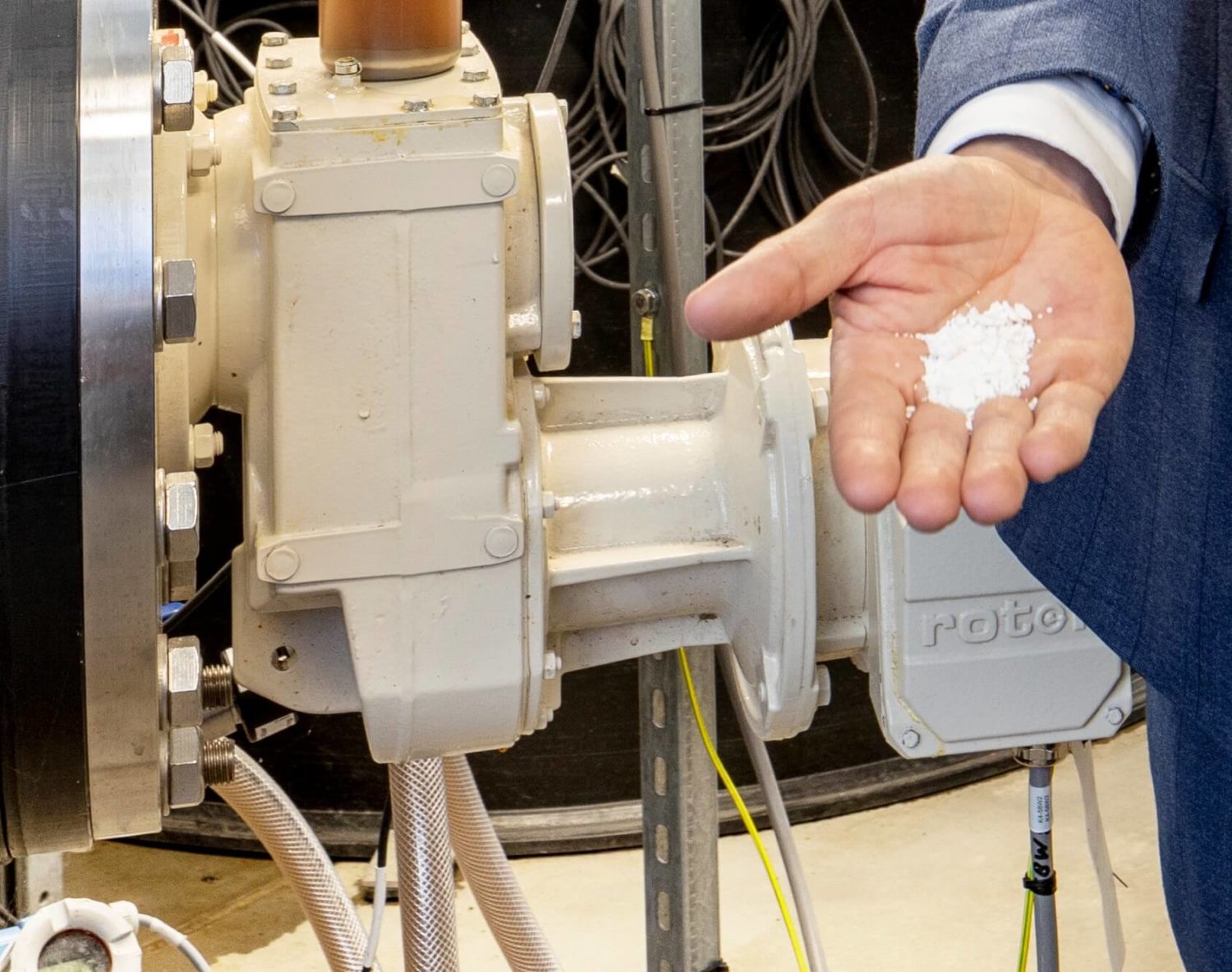
Legion of applications for Caleyda®
Caleyda® can be used as a natural alternative for applications that incorporate regular plastic. Examples include paint, self-healing concrete, clothing and cosmetics. Or in the glue of stickers on our food or plastic coatings that surround certain types of fertilizers. According to Pâques, companies are therefore very interested in PHA: "We are already working with various companies for all kinds of applications. The biggest challenge is only in the quantity. These companies immediately want to buy dozens to hundreds of kilograms to be able to work with it. That is why industrial upscaling is really needed to meet this demand.
Pilot plants
Paques Biomaterials is therefore hard at work with that scale-up of production. The demo plant in Dordrecht has been running for about a year. It was developed and realized thanks to a partnership consisting of the water boards Brabantse Delta, De Dommel, Hollandse Delta, Scheldestromen and Wetterskip Fryslân, knowledge center STOWA, technology company Paques Biomaterials and sustainable energy and waste company HVC. A pilot plant in Emmen will be added this year, for the extraction process.
Setting up the factory in Dordrecht was not without controversy. On two occasions, an EU subsidy was applied for in order to secure funding. Without success. But Pâques was not deterred by this and thanks to the initiative and perseverance of the aforementioned joint venture, it finally succeeded. 'I am really very proud of that,' says Pâques. 'That together you show guts and still persevere, because we all believe in the importance and potential and want to work hard for that before money can be made. That doesn't come naturally, so the opening of the first demo plant was really the first big milestone for us as a company after years of hard work. And for me personally, that was really one of the greatest moments as well.'
No walk in the park yet
Joost Pâques Managing Director Paques
From the plastic soup in the ocean to microplastics in our lungs, Pâques says no one needs to be convinced of the urgency of the global plastic problem. 'I think that was more difficult ten years ago. In that sense, we are on trend, but that doesn't make it a walk in the park. Competing with regular plastic is still an unfair competition as far as that's concerned. What we do is a whole new process, so that makes it even more expensive now in any case.'
Pâques therefore also stresses the importance of a good ecosystem. 'You can't do this on your own. You have to set up new value chains and you can only do that through intensive collaborations. We are therefore also happy with all the help we have received from the NOM and Chemport Europe, among others. For example, we were made aware of the Green Chemistry Accelerator program. That has helped us well with accelerating the scale-up and a broader network in green chemistry.'
Extraction plant in Emmen
The next step in development and scaling up has already been taken. At the GETEC PARK.EMMEN, the second demo plant will be built this year. 'This will then be our PHA extraction demo plant,' adds Pâques. 'With this, we want to first validate the extraction process on a smaller scale. If all goes well, the plan is to open a full-scale extraction plant in 2026. This will have to produce around 6 kilotons of PHA per year. We also consciously chose Emmen. The knowledge, the people, the facilities, it all comes together here.'
Chemport Europe
Chemport Europe is the ecosystem around the sustainable chemical industry in the Northern Netherlands. In it, companies, knowledge institutions and governments work together towards a common goal: a flourishing, CO2 neutral chemical industry. 'An important part of this greening is working in a circular way. And Paques Biomaterials is really a perfect example of this,' says Maaike van Heeren of Chemport. 'This company contributes to a global problem, but also offers enormous added value for the chemical companies in our region.'
As a cluster, Chemport Europe is also involved in the Green Chemistry Accelerator. 'This is a national acceleration program of Invest-NL and the ROMs,' Van Heeren explains. 'It provides startups in the green chemistry sector with customized support to accelerate the funding of pilots and demo plants. That was exactly what Paques Biomaterials was looking for, so we immediately pointed them to this program.'
'For startups and scale-ups working on these kinds of sustainable innovations, it is sometimes difficult to really get a foothold in the chemical sector,' Van Heeren continued. 'We try to help these kinds of companies grow healthily in all kinds of ways. That might include help with scale-up, testing and validation at our test sites, or finding the right location. In the case of Paques Biomaterials, Emmen is also the most logical location for their upscaling in that respect.'
