
EDIH NN recently introduced the Smart Makers Academy Noord. The initiative offers companies in the manufacturing industry a great opportunity to take concrete steps towards a digital future with short, accessible training courses. 'The pathways are explicitly tailored to practical situations.'
Unmanned and self-directed systems, robots, sensors, data technology and the meteoric rise of artificial intelligence (AI). Yes, the impact of new technology on industry is enormous. Not least on the manufacturing industry. But besides opportunities, it also threatens the very existence of companies that do not catch on in time. Better put: further digitalization is no longer a choice in industry, but a necessity to stay afloat in the future.
'Of course it's great that you can automate an entire factory these days,' says Wilbert van den Eijnde, Associate Lecturer in Sustainable Manufacturing at NHL Stenden and Skills & Training Specialist at EDIH NN, a European project for the Northern Netherlands that helps companies accelerate digitization. 'But I also see that we still have a long way to go. Because the manufacturing industry is already very smart, but in Europe, and therefore also in the Northern Netherlands, the opportunities in the SME sector are still insufficiently exploited. That's why we developed the Smart Makers Academy Noord. Last October 22 it was launched during the Future Ready Event.'
Short and powerful learning paths
The Smart Makers Academy Noord is an initiative of EDIH NN and is co-sponsored by FME, Hanzehogeschool, NHL Stenden, University of Groningen, Cyber Security Noord, Koninklijke Metaalunie and NXTGEN Hightech.
Based on a national concept, it consists of five short, powerful and flexible learning paths to put companies on the right track toward a digital future. Whether it is about discovering new business models, applying AI or increasing the company's digital security, each track leads to a concrete (action) plan tailored to current learning needs, ambitions and challenges of individual companies.
'The Smart Makers Academy is very accessible in several respects,' underlines Marike Peterzon, lecturer, project leader and senior researcher at the Hanzehogeschool and active within EDIH NN as Digital Skills Officer. 'They are not theoretical courses, but explicitly tailored to practice. Nor is it a long-term program
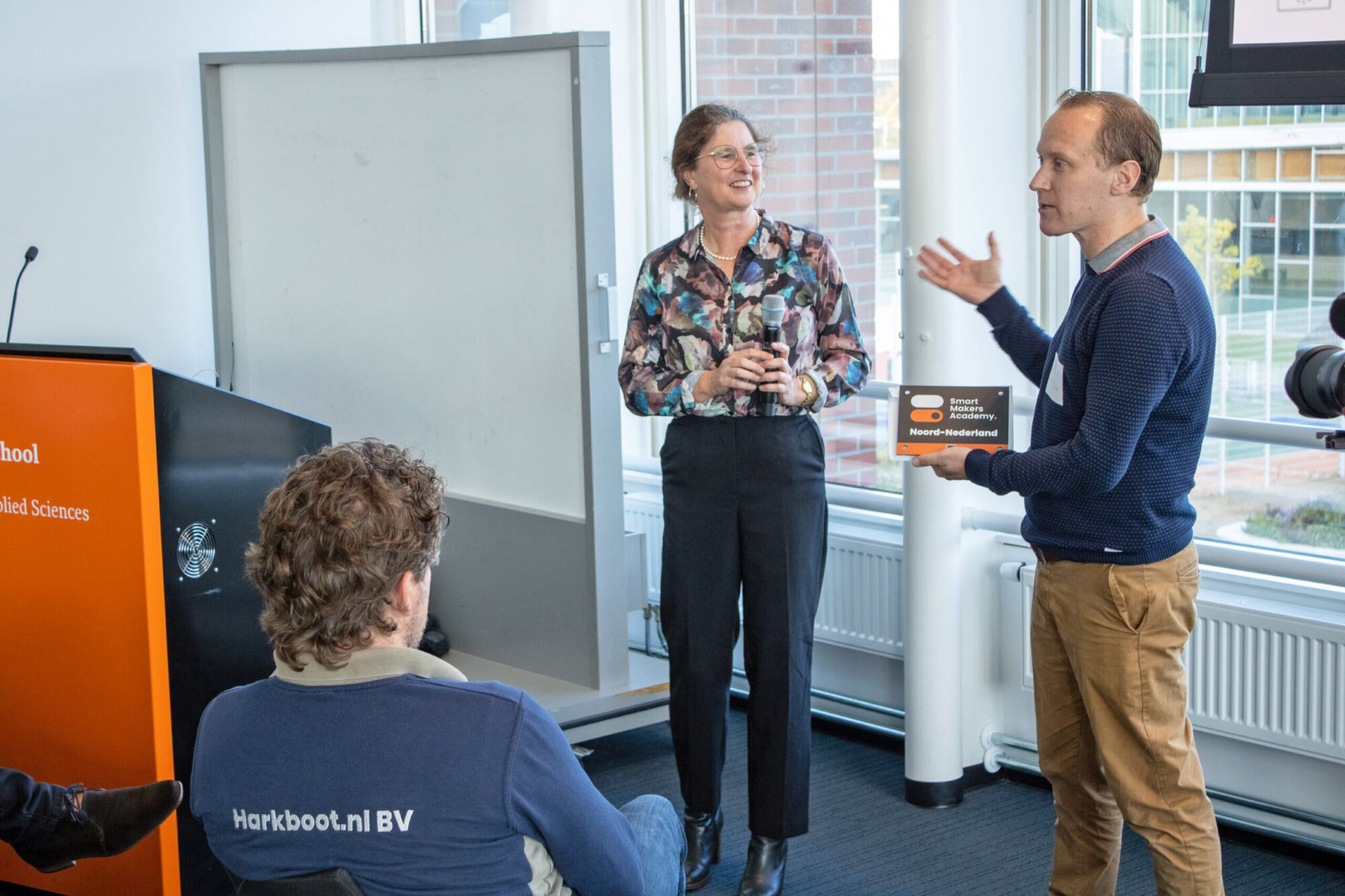
the national SMA award to Marike Peterzon.
Knowledge gaps
Together with Wilbert, Marike is responsible for the Smart Makers Academy Noord within EDIH NN. Last year, they also wrote the Master Plan for Skills in Smart Industry, a plan designed to help industry in the Northern Netherlands keep pace with rapid technological developments in the sector. “During the research, it became very clear that the lack of skills is a major obstacle to taking the desired steps,” says Wilbert. “Companies usually have the technology available, but how they can and should best apply it in their daily operations is often still uncharted territory. It’s not uncommon for knowledge gaps to lead to uncertainty. In addition to raising awareness, the Smart Makers Academy Noord therefore focuses heavily on overcoming hesitation to take action.”
Of course, the so-called frontrunners in the market usually know how to find their way to knowledge institutions and subsidies, for example. However, for a large number of relatively small manufacturing companies, due to various circumstances, it appears to be less easy to discover the desired programs and adopt new technology. While they undoubtedly all know how important digitization is for their future-proofing. 'Especially for these companies, Smart Makers Academy Noord is a nice stepping stone to be able to use practical digital skills effectively in their company later on,' Marike states.
Subway lines
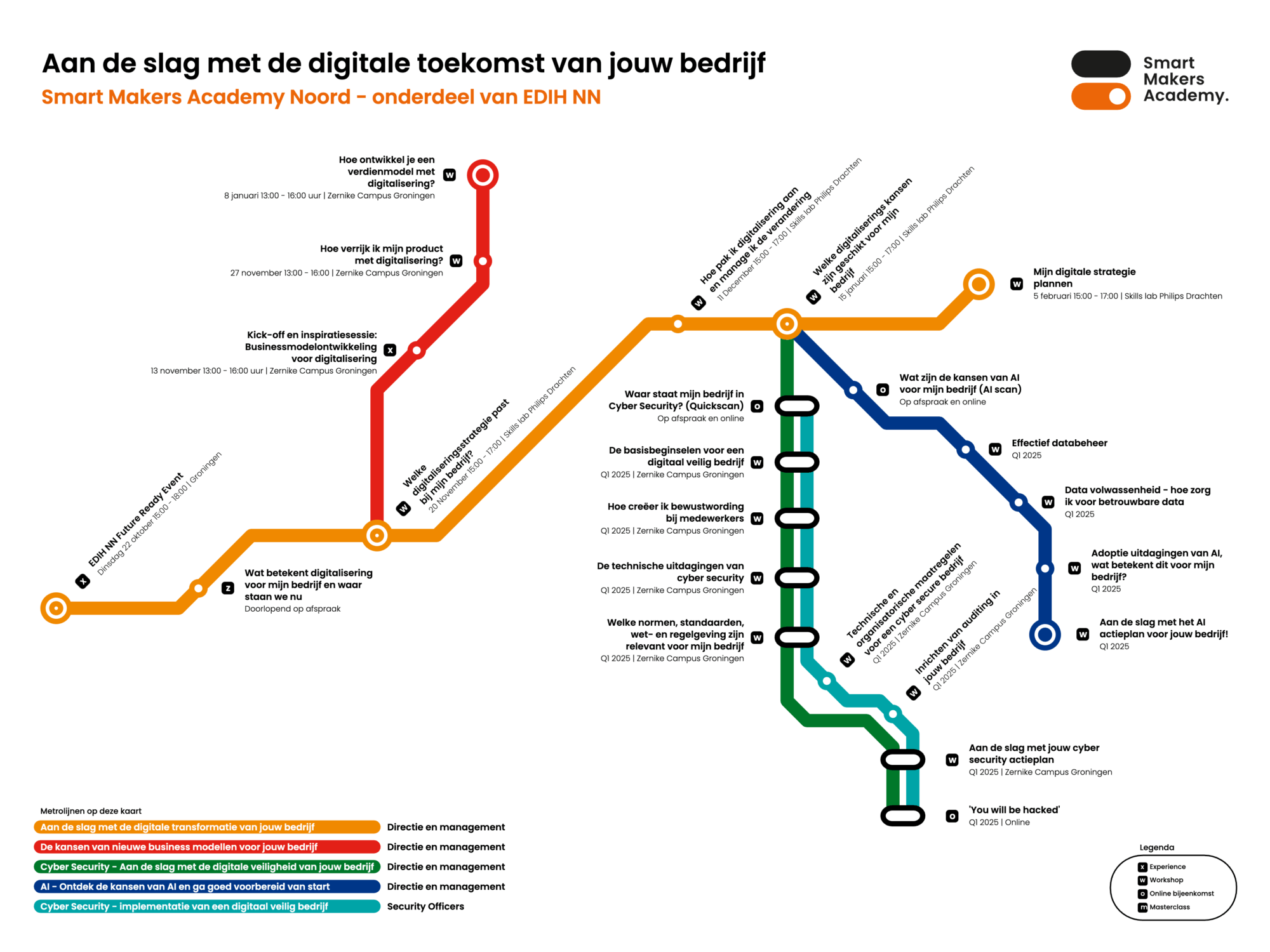
The learning paths are organized based on a 'metro lines' concept. There are several metro lines, which can be seen as flexible learning routes, each with its own theme and several 'stations'. Each 'station' represents a module in which specific skills around that theme are covered. The great thing is: participants can easily 'hop on and off'. So everyone can choose their own route and decide which skills they want to develop.
The Smart Makers Academy Noord currently has five metro lines. There is a central line where participants get to work developing their own digitization strategy. And once on their way, they can easily switch to a line where they discover the opportunities of new business models for their company, to a line that guides them step-by-step in preparing to apply AI or to one of the two lines around the topic of cybersecurity.
Free zero measurement
A more than valuable starting point are the scans, including the Cybersecurity scan and the AI scan. They are designed to help participants discover their starting level and learning needs. 'So you immediately know where you are at that moment, what you need and where opportunities lie,' Marike explains. 'So basically, it's a free baseline measurement for companies. In addition, at the end of a program you not only know where your weaknesses are, but also how to address them.'
No, the Smart Makers Academy Noord is by no means just an educational event, Wilbert argues. “On the contrary, we actually draw our expertise from the field. Simply because the way we approach a theme—such as a metro line—must align as closely as possible with the needs of the manufacturing industry. We also collaborate with entrepreneurs and other experts to determine the next step after each learning program, such as follow-up training or the implementation of new technology. I’ve noticed that there’s still a perception that training only takes place in the classroom. Whereas, in our view, real learning happens within the companies themselves. That’s why we want to validate participants’ competencies by issuing a certificate. We’ve just gotten started, but I’m convinced that the Smart Makers Academy Noord can make a significant contribution to the growth potential of the regional manufacturing industry.’