
If we all want it, it will work. It was without doubt the main conclusion at the Innovation Table on Food Transition held Wednesday, Sept. 28, 2022, at the Avebe Innovation Center on Campus Groningen. 'We need to be bold and show that we are leading the way.'
The event was the second in a series of innovation sessions organized by NOM and Campus Groningen, under the name Power of Groningen, around a topic relevant to the Northern Netherlands. The main goal: to bring companies and organizations together and facilitate and encourage new collaborations and initiatives. This time it was the agrifood sector's turn to inform and inspire each other about current and future developments surrounding food transition.
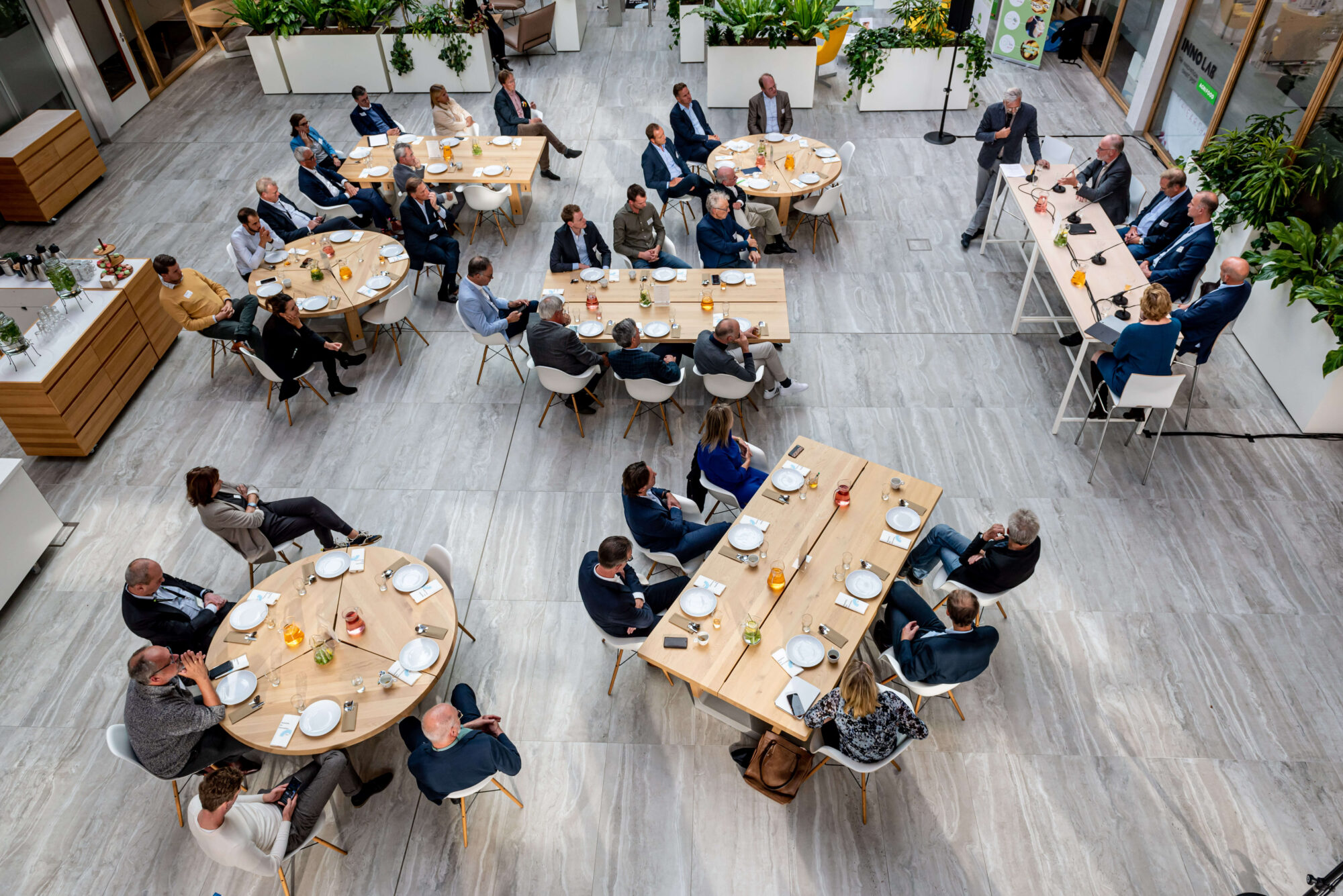
Indeed, a radical change of the food system. A topical and urgent issue, to be sure. Because with the growing world population, the demand for sustainable and healthy food is also increasing. Especially the demand for protein and protein-rich products. At the same time, global warming is forcing us to reduce animal production and consumption. Hence, during the Innovation Dinner, the approximately 40 participants literally sat down together, the focus was on the protein transition: the transition from animal to vegetable and new sources of protein.
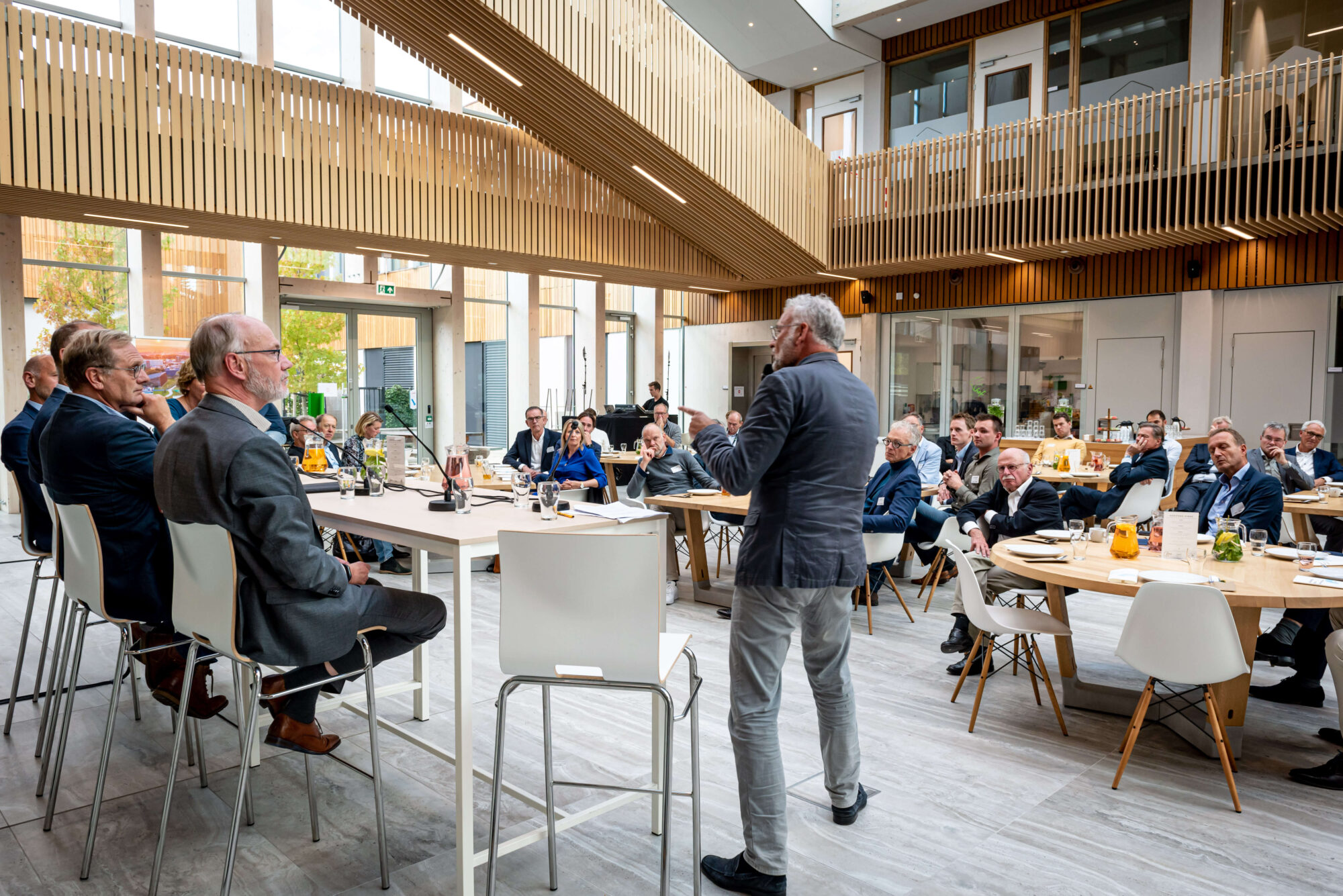
'The food transition contributes to combating climate change, a healthy and balanced lifestyle and a sustainable agro chain,' kicked off writer, journalist and moderator of the day Jeroen Smit. 'Anyone against?' No one, of course. Not least because the Northern Netherlands in particular can play a major role in accelerating that transition. Just think: the region has the agricultural area, has several large agricultural cooperatives, plays a pioneering role in the field of green energy and also has a lively agrifood sector and knowledge institutions with a great deal of expertise in (food) matters. And yes, these are of course the ingredients for an ideal joining of forces.
The TopDutch region may well have become a big name in food transition worldwide by 2035.
Dina Boonstra (director of NOM)
Looking to the future
Assuming all goes well in the coming years, Smit asked the guests at the central roundtable, what would 2035 look like in terms of food transition? 'I am convinced that we will then be able to make high-quality plant-based proteins,' was Peter de Jong's hopeful answer. 'By that I mean independent plant-based ingredients that have great added value to our entire diet. All realized in a protein plant that we will then have here for quite some time.' The dairy process technologist was present on behalf of Fascinating, an innovation program in which agricultural cooperatives Avebe, Agrifirm, Cosun and FrieslandCampina, together with the UMCG and LTO Noord, among others, are working on a circular food system.
Dina Boonstra, director of the NOM, also looks ahead with confidence. 'It is quite possible that by 2035 the TopDutch region will have become a big name in food transition worldwide. That governments, entrepreneurs and investors will know that for smart solutions and innovations they have to be in the Northern Netherlands. Simply because here are the facilities, the people and the knowledge that can help them move forward.'
Reducing energy needs essential
Expectations are high, it appears. As mentioned, there is every reason to be. Yet there are still some bumps to be taken. For example, a reduction in energy needs, especially in times of exploding energy prices, is essential to accelerate system change. Drying plant proteins alone, for example, is quite energy intensive. So to prevent promising initiatives and projects from failing prematurely, opportunities to rely less on fossil energy sources must be sought.
But how do you achieve energy-efficient and sustainable processing? During the Innovation Dinner, it became clear that the North is working hard on possible solutions. Think of the development of new technologies to retain more valuable nutrients, to optimize the value of residual and side streams and to dewater and dry more intelligently. Or think of innovations to convert by-products into energy and use part of it for their own energy generation.
Hydrogen is also mentioned as a potential building block for food transition, of course. 'After all, the region has the ambition and potential to become the green socket of the Netherlands,' says Teun van der Weg, Innovation Manager at Royal Cosun. 'We ourselves, for example, are affiliated with H2-agri, a partnership that is exploring the possibilities of producing green hydrogen for agricultural companies in Groningen and Drenthe. That's small-scale, but large-scale is happening in the Eemshaven. Of course, we're not there yet. The fact is that gigantic strides have been made in recent years and hydrogen is becoming increasingly important. '
If you do nothing, nothing will happen.
Edward van der Meer (director of Campus Groningen)
Everyone must participate!
The food transition will succeed only when all relevant parties join in and cooperate intelligently and thoughtfully. Governments, the agricultural sector, industry and science. The great thing is: the Northern Netherlands is the pre-eminent region for experimentation, testing innovations in practice and scaling them up if they prove successful. Campus Groningen has all the knowledge, expertise and talent to make a solid contribution to the much-needed transformation from animal to vegetable proteins, including at the Avebe Innovation Center, Innolab AgriFood and the UMCG.
Edward van der Meer, Director Campus Groningen 'If you innovate together, it is important that you learn to speak each other's language. But companies must also be aware that when you start implementing technologies and translating them into processes, technology and production are not always synchronous. It may well be that one company benefits immediately, while another has to wait a while. You have to accept that. If you do nothing, nothing happens.'
And of course there is Fascinating, where Avebe, Agrifirm, Cosun and FrieslandCampina are currently working on a plan for a real protein factory. The new factory, a so-called shared pilot facility for which about eight years have been set aside, is to produce vegetable proteins from various crops grown in the region, including potatoes, field beans lupin and beets. SMEs, essential to the success of the food transition, are also working on a similar project. In fact, the SME protein factory should be there by 2024. 'In our case it's about functional proteins,' clarifies Bert Knol, who took a seat at the central roundtable on behalf of northern SMEs. 'We are going to make semi-finished products for food companies for meat substitutes, sauces and stabilizing foam, for example.'
Showing guts
Nice of course all these dreams and ambitious plans. But can they be financed? They certainly can, it sounds promising. The condition is that substantial savings are made on energy needs, that we continue to focus on what we can make in the region and that the joining of forces is based on good leadership. At the same time, the transition and its funding require appropriate laws and regulations to speed up processes and make them more efficient. 'It is advisable to involve parties such as the NOM and Campus Groningen in projects at an early stage,' Dina Boonstra emphasizes. 'So that all funding questions can be answered in a timely manner.' In short, the Northern Netherlands has everything it needs to play a leading role in the food transition. But that is not all. To gain speed, we, the business community and knowledge institutions, must also show that we in the region are engaged in great adventures.
Show courage and really want to go for it together. If that happens, everyone will catch on, including administrators, subsidizers, banks and risk investors. Moreover, it will greatly facilitate the search for talent. That too is not an unimportant fact for now and later.