
How do you remove PFAS from water? What do you do with PFAS found in dredged material and organic matter from waterways? And once you’ve captured and concentrated the PFAS, how do you ensure it’s actually removed from the cycle?
Through the PFAS Challenge Edition, the municipality of Leeuwarden, in collaboration with its knowledge partner CEW, is seeking innovative technology companies that can contribute to addressing three interrelated issues. ChallengeBase, the NOM’s innovation challenge program, is searching for solutions both in the Netherlands and abroad.
The goal is clear: to identify technologies that can be tested in practice and ultimately contribute to a structural approach to the PFAS challenge.
Toward a site that can be used again
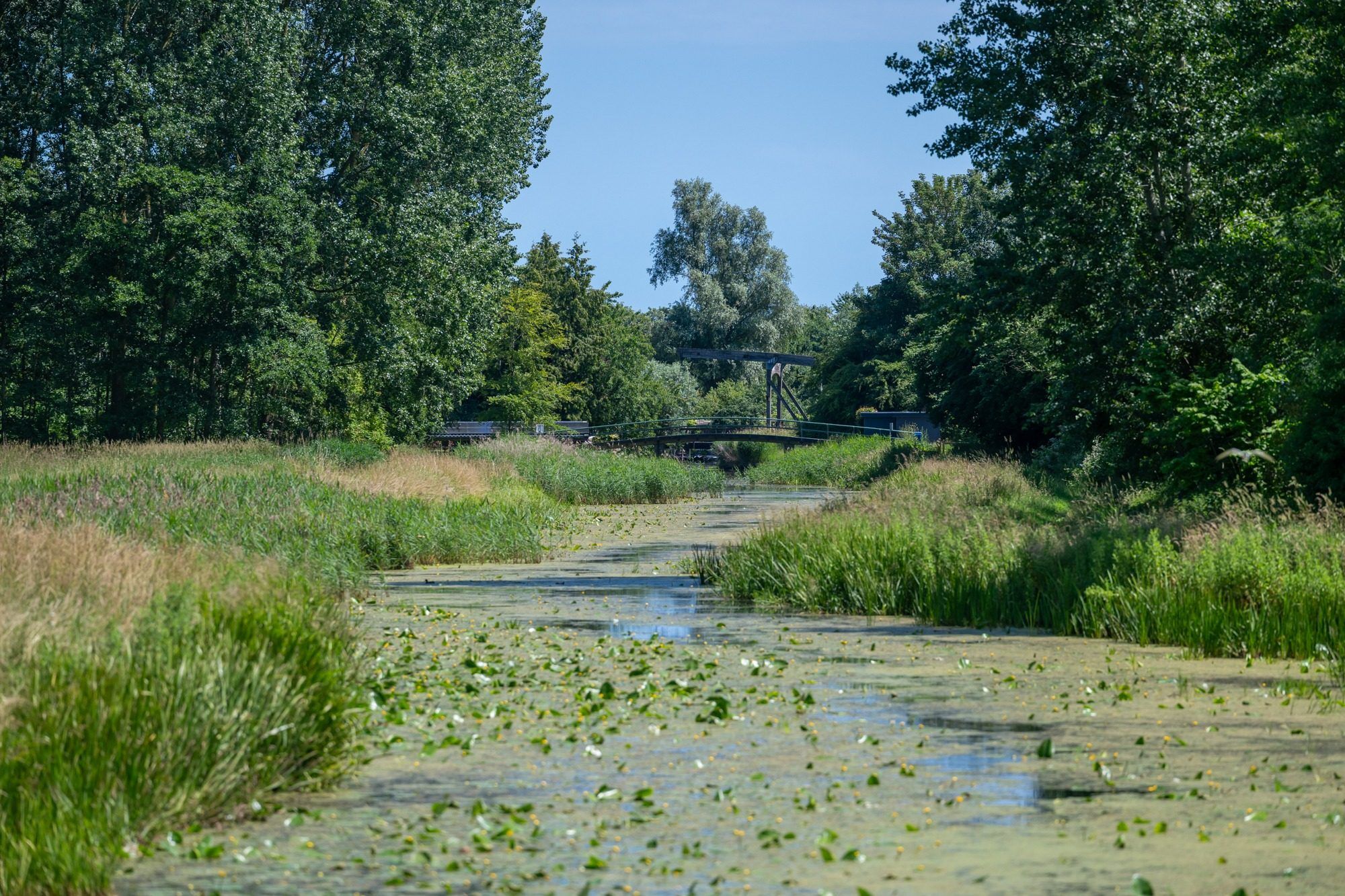
In the affected area, PFAS are present in, among other things, surface water, the riverbed, and organic material from the waterways. As a result, restrictions are currently in place on activities such as swimming, fishing, and irrigation.
The City of Leeuwarden ultimately aims to reach a situation in which the area and the water can once again be used safely and without concern. This will require not just one technique, but likely a combination of solutions.
The three innovation challenges have therefore been designed as components of a single treatment chain.
1. PFAS in water
The first challenge focuses on removing PFAS from surface water and other PFAS-containing waterways. This involves more than just cleaning the water. The PFAS must be concentrated as much as possible into a manageable residual stream that can then be further treated or destroyed.
2. PFAS from dredging and construction slurry
During routine maintenance of waterways, materials that may contain PFAS are generated, such as dredged sediment and removed aquatic plants. The second challenge seeks technologies that can reduce the PFAS concentration in these materials, thereby creating new opportunities for processing, application, or reuse.
The same applies here: simply transferring PFAS from one material to another waste stream is not enough. It must be clear what happens to the captured PFAS further down the chain.
3. Destroy PFAS
That’s where the third challenge comes in. Because removing PFAS from water or materials doesn’t mean it’s gone for good. That’s why we’re looking for technologies that can demonstrably and irreversibly destroy PFAS.
From Technology to a Pilot Project
The challenge doesn’t end with finding an interesting idea. Promising technology companies will have the opportunity to further discuss their solution with the City of Leeuwarden and CEW.
One or more solutions may then be selected for a practical pilot. CEW is involved as a knowledge partner and can provide support in areas such as pilot design, monitoring, and validation. This offers technology companies the opportunity to test their solutions on representative waste streams, further substantiate their performance, and take the next step toward scaling up.
Ultimately, the ambition goes beyond a single pilot project: solutions must contribute to an approach that can be applied on a larger scale and gradually restore the area to usable condition.
Do you have the solution?
Do you work at a startup, scale-up, innovative small or medium-sized business, or technology company with a solution that addresses one of the three challenges?
If so, ChallengeBase would love to hear from you. A technology does not necessarily have to cover the entire treatment train. Even a specialized solution for a single specific step could be exactly what’s needed.
Check out the three PFAS Innovation Challenges and sign up via ChallengeBase.
Want to learn more first? Meet the challenge owners during the webinar
Before submitting a proposal, would you like to learn more about the challenge, the available waste streams, or the possibilities for a pilot project?
On Wednesday, November 25, ChallengeBase will host webinars for companies considering participation. During these webinars, the experts involved will provide further details on the challenges, and there will be an opportunity to ask questions directly to the City of Leeuwarden and CEW.
Sign up for one of the webinars on November 25.
Do you know a company that could contribute to this?
You may not have the technology in-house yourself, but you might know a company that specializes in PFAS removal, concentration, treatment, or destruction. Please share these challenges with your network.
Do you know of a company that ChallengeBase should definitely reach out to? Please contact Joline Teisman, challenge coordinator at NOM: teisman@nom.nl or +31 6 272 549 73.
Suggestions from both Dutch and international technology companies are welcome.
Do you have an innovation question that the market hasn’t answered yet?
The PFAS edition is one example of how ChallengeBase works. As the NOM’s innovation challenge program, ChallengeBase helps companies and (semi-)governmental organizations tackle issues for which no ready-made solution is yet available on the market.
Together, we’ll refine the problem. Then we’ll conduct a targeted search for startups, scale-ups, and innovative companies that can offer a solution—in the Northern Netherlands, the rest of the Netherlands, or internationally. We’ll guide the selection process and remain involved in the next steps toward collaboration and implementation with the partner you’ve identified.
Do you encounter a technical or sustainability issue within your organization that makes you think, “There has to be a solution to this somewhere”?
Please contact Joline Teisman. Together, we’ll determine whether your issue is suitable for the next edition of ChallengeBase.