
How do you go from a well-thought-out idea to a prototype to test the innovation in practice? That step often costs a lot of money, and investors want to see that it works first. It’s a chicken-and-egg situation where the FOM steps in to help with Early-Stage Funding (VFF). Equinox Ocean Turbines is a good example of a startup that needed early-stage funding due to large capital investments.
"The biggest challenge now is to bring forward private investments."
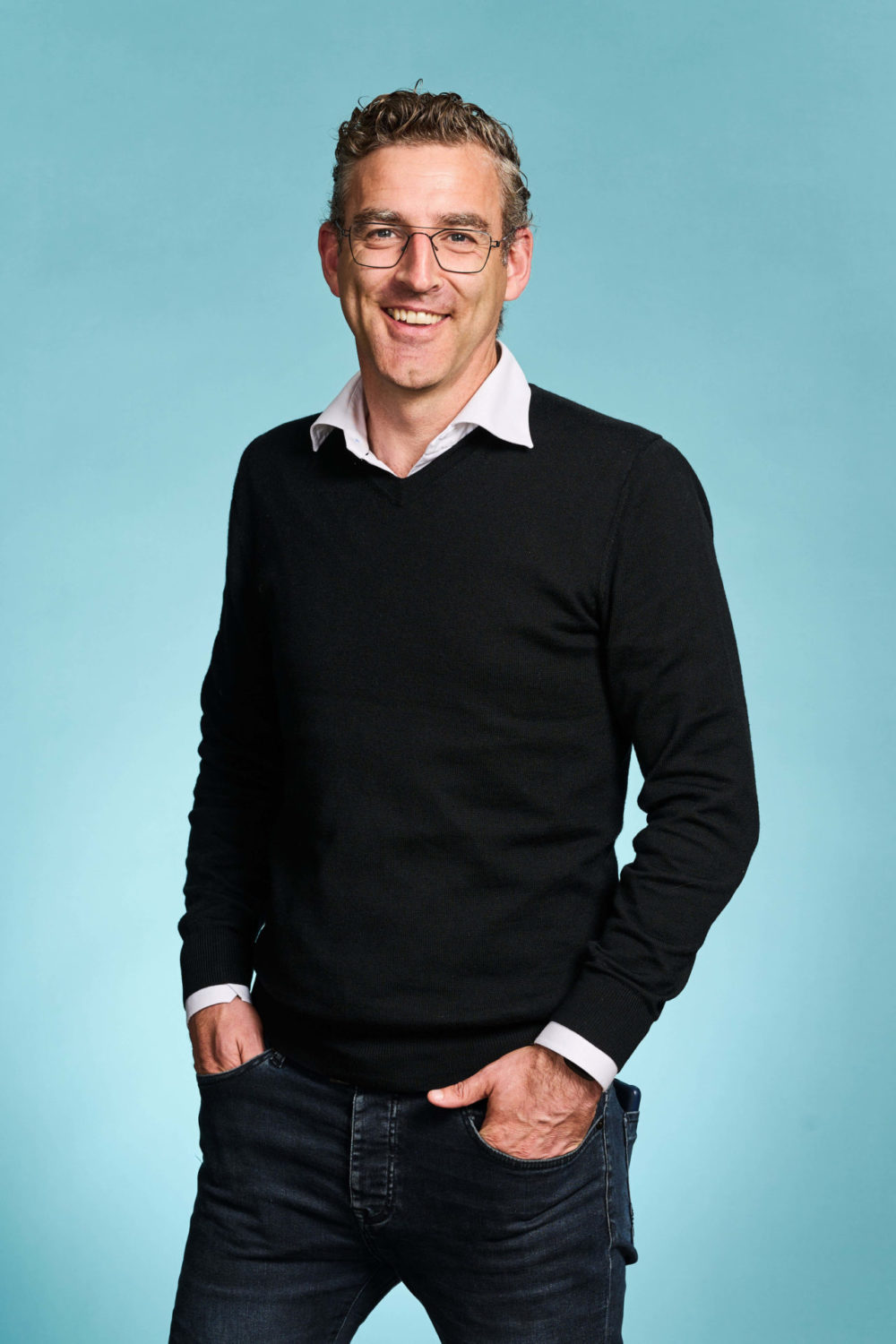
Rob Drees FOM
In early April, FOM took over the administration of the Early-Stage Funding (VFF) program from RVO, which had traditionally administered the program from The Hague. “The advantage now is that the program is in the hands of people who are active in the region and familiar with it. This makes them more accessible to entrepreneurs,” says FOM Director Rob Drees. “The new situation also helps us better coordinate the various components of the funding process.” In fact, the FOM not only provides the VFF loan but can also offer follow-up funding. This enables the development agency to better provide entrepreneurs with tailored funding, along with guidance and access to its network throughout the entire process.
Ocean turbine as an example of capital-intensive innovation
One of the companies that could really use funding in the start-up phase due to significant capital investments is Equinox Ocean Turbines. Based in Leeuwarden, the company designs systems that generate energy from ocean currents. Founder and CEO Pieter de Haas has a background in shipbuilding but has been working on marine energy concepts for years. For example, with a previous company, he supplied the five turbines that converted tidal currents into electricity at the Ooster Scheldekering for eight years. Together, they generated 1.2 MW—enough to power more than 1,200 households simultaneously. De Haas learned that tidal power also has its drawbacks. The power supply is not constant, as it depends on the tides, and flow velocities are extremely high at peak times. “That’s good for the yield, but bad for the infrastructure surrounding the turbines—and therefore costly.”
De Haas has therefore now turned his innovative and entrepreneurial talents toward the major ocean currents. Day in and day out, these currents push seawater in the same direction. “Such a current moves slowly. That’s why we’ve designed a large, slow-rotating rotor that drags small rotors along at its tips, which in turn drive generators. The speed is much higher at those tips, which is why these turbines generate energy so efficiently. Such a system generates about 2 MW, comparable to a large offshore wind turbine.” The entire system floats underwater like a buoy and is held in place by an anchor. An array of these systems placed side by side can thus generate a large amount of energy.
Venture capitalists are hard to find
The large rotor has a diameter of fifty meters, making it a massive installation that will be built largely at a shipyard. For a proof-of-concept, Equinox Ocean Turbines is first working on a 1:10 scale model. Despite the scale model’s smaller size, its construction and installation at sea still require significant investment. “Renewable energy projects are costly and require long-term investments. You won’t have a finished product or market results within two years. We need venture capitalists with vision and patience. They can sometimes be hard to find.”
Drees considers the developments at Equinox Ocean Turbines a prime example of a startup that could benefit from the VFF program. “Many good ideas don’t make it to market right now because the necessary capital is lacking, especially in the early stages of development.” With the VFF, FOM aims to fill that gap. With a budget of 6 million euros, FOM can assist companies with grants ranging from 50,000 to 450,000 euros per application.
"Renewable energy projects are costly and require long-term investments."
Pieter de Haas Equinox Ocean Turbines
VFF facilitates crucial proof-of-concepts
Meanwhile, Equinox Ocean Turbines is nearing the next phase. The scale model is scheduled to be deployed at sea after the summer. There is considerable interest in the approach, particularly from Japan. This is putting innovation from the Frisian business community on the global map. Drees: “Now that the FOM has successfully supported the early phase, my biggest challenge is attracting private investment.” He still sees a gap between FOM support and the parties truly committed to enabling the scaling up of larger innovations through follow-on funding. “The VFF program is therefore very important for providing the initial proof of concept that is crucial for attracting larger investors.”